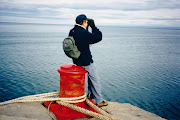
Friday, August 28, 2009

High Functioning


Jenny wants, she tells me as I hand my cash over the register to her, to do research into autism. As she says this she's working one of her three day jobs: this one is as a front-desk person at a resort just west of Sedona, Arizona. Her other jobs include waitressing at an upscale restaurant back in town, and peddling Mary Kay Cosmetics. And when she isn't serving wine and tapas or passing around lip gloss, she's attending classes at Northern Arizona University, where she majors in psychology.

"So why autism?" I ask, curious, as she hands me back my change. "Do you know someone who is--"

No, no, she interrupts me, wrinkling her freckled nose. But she's still determined to find out what causes it. She doesn't think, for example, that autism in children can be set down merely to an inappropriate regime of vaccinations. Some combination of factors, she tells me, brushing her short, blond hair behind her ears, must be at work--maybe a genetic component coupled with an environmental factor, which was only then coupled with a problematic inoculation. And then, she smiles at me confidently, there was also the widely ranging nature of the condition itself to consider.

"So you want to work with autistic children?"

"No. Just do the research side. I'm more a behind-the-scenes sort of gal."

We fall to discussing a documentary we'd both seen recently, about an autistic scientist who has done some unusual and very successful work with animals.

"The one who doesn't process in terms of language?" Jenny asks me.

"That's right. She 's thinks in color, I think--and spatially."

"Right. The one who helped cattle processors understand why their cows were so terrified to go down the chute."

"So she went through it herself, and could see exactly what it was that was making them so afraid. The way a certain black, square shadow fell just across the gate. Right before."

"So they fixed that."

"And now the cattle go in calmly. She helped them. The processors, I mean."

"Well, and the cattle."

"If you can call preparing an animal to be a steak helpful . . ."

"Well if it has to go," she shrugged, and I imagined it was the waitress in her pinching her shoulders together, "I'd say it might as well be helped to go peacefully."

Then I confided to her that a member of my own family suffered from a mild version of autism known as Asperger's. My twenty-something relation was able to live on his own, but he had trouble holding onto a job, and with authority, and with his unsympathetic neighbors.

"High-functioning." Jenny shook her head, sighing. "Not always so easy. So . . . what do you do for a living?"

I answered that I was a writer, a speaker, and a workshop leader. Also that I trained dogs, just for fun.

"So you have a degree of some kind?"

"A couple of them."

"Wow. You're lucky. Me, I'm thirty-five years old, and if there's one thing I've learned after fifteen years of no schooling and of having every kind of job you can imagine, it's that nobody pays any attention to what you have to say about anything important unless you have a PhD."

"Then you must be planning to go to graduate school?"

"Berkeley." She shut the front-desk register definitively, almost angrily. "I'm aiming high. So nobody will be able to ignore me because of what they think they know about me. Oh, wait, you want want of these?" she added, and from the holder next to her pulled out one of her Mary Kay sales cards.

In the glare of the bright lobby light I registered its pretty, soothing pink.

--MD


Photo credit: Bruce Barone

Friday, August 21, 2009

Valley of the Gods


"Moki" is a Hopi word for "those who are gone," or "the people who have left." A winding, gravel road that contracts into three miles of hairpin turns cutting deep into the sides of a mesa above Valley of the Gods, Utah, is called the Moki Dugway. Parking at the top to look down into the Valley with its red buttes and eerie hoodoos, I met Dale, from Eastern Oregon.

I told him he seemed to be a long way from home; but no, it turned out he wasn't at all.

As a boy he had lived in a remote corner of Utah called Granite Canyon, and he'd come back many times, he told me, to visit what was left of his family's old homestead. This time he'd brought his wife, Patsy, with him, and his dog, named Bo. All three of them were comfortably retired--Bo napped at our feet as we clutched our sunglasses in the stiff wind above the dugway--and all had recently moved to Oregon to be nearer Dale and Patsy's children. But their hearts were still embedded in red rock.

Granite Canyon was so remote, Dale told me, that in the 1920's it had been a day's ride on horseback into tiny Cisco just to get the mail (Cisco isn't much more than a ghost town even now--I've seen it, and if people are living there, they don't want you to know about it). His mother had met his father getting the mail in this way, as they both crossed the Dewey Bridge at roughly the halfway point. They soon married and settled down in the Canyon to raise their children and cattle. Each time one of Dale's siblings had been about to burst into the world, his pregnant mother had mounted her horse, riding toward Cisco in hopes of catching the train in time to reach Grand Junction, Colorado, and the doctor. Usually, though, she didn't get close.

"In my case, she didn't," Dale grinned. "I was born in Utah."

It was a perfect life for all of them, tucked away in the hidden canyon, he said; but it all began to unravel with the passing of the Grazing Act. Soon "sheepmen," as he called them--I was fairly certain he wanted to spit the two thousand feet down to the Valley floor as he said the word, but was too much a gentleman in his nice clean windbreaker to do it--intruded themselves on the scene. The sheepmen weren't so gentlemanly, and they dynamited the passes that Dale's family used to bring their cattle down from the mountains and into the grazing fields. The ranch couldn't survive this and other explosions of the time, so the family at last gave up, sold out and left.

"After a long time," Dale said, reaching down and patting Bo, "I was finally able to bring myself to go back." All that remained was the chimney of the main house, and the ruins of the old root cellar.

"But the cabins in the mountains that we used to have for our summer camp were still standing, and the local people there still call them by our family's name. They're still called the Wood Cabins. I mean it. If you go there, you can see for yourself."

"So . . . this was definitely worth the climb to get up here, wasn't it?" he straightened and turned to Patsy, and then looked down.

"Yep. We definitely don't have anything like this in Oregon."

"Why our children would want to live in Portland is way beyond us. We won't, will we, Patsy? Not enough sun."

I asked him if the rest of his family had been back to see the old place.

"Oh, yeah. I took my brother there and showed him, and his face just lit up. Just lit up. At nothing but the chimney and the root cellar. Nothing much at all. But it was special. Just to be able to show him that we were still standing." And Dale stood and balanced and looked out over the twists and turns of the blasted pass below us, named for those long vanished.

--MD

Monday, August 17, 2009

Santa Maria, California


I didn't know, until I met Dennis, that you could grow organic vegetables inside a small, ancient, crowded RV.

"These here are my sprouts," he showed me. "And here is some kale. And here," he pulled a Tupperware container from somewhere deep in the dense interior, "just take a look at these." He handed the bowl to me, and I looked down at an orgy of naked, thread-tailed, perfectly fresh beans.

Scraggle-bearded, tanned, lean in short-shorts and rough hiking boots, Dennis is someone I'd just met at a gas station where our two rigs had nearly collided. I'd gotten out and apologized, and he'd tilted his bleached head of hair toward me.

"You're not from around here, are you?" he said. "You're too nice. I can tell from your accent you've spent time in the South. Texas, my bet."

"How'd you know?"

"I can pretty much place any accent, I get around the world so much."

Dennis travels and lives in his battered camper with his surfboards on top, his bike suspended on the back and ladders hung from both sides. Also with a big, yellow, part-wolf, part-Akita named Suki in the cab. Inside his mobile home is his store of vegetables and jewelry. When I told him I was a writer, he told me he was at work on a book about "how to practice organic methods whether on the road or at home," and as we walked our dogs around the littered margins of the fuel pumps he added that he'd just come from three months of very helpful meditational studies down at the Agape Church in Los Angeles.

"I had to. To clear my head. You wouldn't believe how bad it's gotten. That's how I knew you were from out of state. People here are so angry. They spend too much time stuck in traffic, and fighting over the things that are disappearing. What I want is to teach people how to live simply and be at peace. We're going through a dangerously transitional time in this world, and we need to learn to love each other again."

As our dogs stepped gingerly over the tossed Doritos bags and trashed grass, I couldn't deny it.

For fifteen years, Dennis told me, he's been supporting his simple lifestyle by selling jewelry. Every year he makes a pilgrimage to Tucson to the trade show there, and stocks up on, as his card reads, "Natural Stone Bracelets, Hearts and Beads, Amber Necklaces, Pendants from Europe, Coral and Turquoise Nuggets, and Hemp, Coco and Puka Shell" classics. Then he drives up and down the coast selling his wares to surf shops, boutiques, and metaphysical dens.

"I used to make $2,000 a week. Now it's down to $600. People don't necessarily need crystals. Jewelry is a luxury. It's not like enchiladas or tacos."

I asked him if he was happy, and he admitted he had his moments, that it was all hard work. But life was still good. He began every morning surfing. Then, at mid-day, after making a few sales, he went swimming. He'd been on the road for so long he knew every public swimming pool between Santa Barbara and Half Moon Bay.

"And today is like that?" I asked him.

He nodded, and showed me his list of appointments. Then he looked down at his watch, and excused himself and his dog, because they had to get moving. He had to get to San Luis Obispo; the swimming pool there opened at one o'clock. Before he left, he wrote his website down for me, where he told me I could find his delicious recipes for simple, affordable, organic foods. You can read more about Dennis' beans and cookies at:

www.professorsprouts.com

--MD

Photo by Bruce Barone

Sunday, August 9, 2009

A story submitted by my friend . . .

. . . Weezie Kerr Mackey, just a few days ago. Weezie is wonderful writer and the author of the young adult novel, Throwing Like a Girl. Be sure to visit her sparkling website and keep your eye out for her next novel. Weezie lives in Houston with her husband and two sons; you can leave comments on her story, "Honeymoon," below, or contact her directly through her website. Now, let's all enjoy a good snuggle!--MD

Honeymoon, by Weezie Kerr Mackey


During a thunderstorm last night, Matthew, my seven-year-old, came into my room and said, "I'm so scared I could cry." I said to come up and he flew into bed where I was reading.


He said, "Tell me a happy story. Tell me about your honeymoon."

I told him about Copper Harbor, the Upper Peninsula of Michigan, in February. A story he knows well.

After a while he said, "I wonder where I will go on my honeymoon."

We both watched the ceiling fan. I rested my open book on my chest and said, "It might depend on who you marry."

He said, "Maybe Australia. That's a really big island."

"Also it's a continent."

"I know," he said. "Or Pennsylvania. They've got a lot of interesting things to do there. Like that bell with the crack."

"The Liberty Bell."

"And the lady who sewed the American flag. She has a house there."

Matthew's first grade teacher, Ms. Allen, was from Pennsylvania. A great deal in his life last school year revolved around what Ms. Allen said.

"Or Hollywood. New York City. Are people allowed to go through the Great Wall of China?"

I wondered how to answer the "through" part of that question.

"What kind of girl do you think you might marry?" I asked, moving on.

"Pretty and cool, kind of like you because you love Daddy so much."

When the rain stopped and when he knew the time was coming for him to go back to his own room, Matthew said, "Your bed is so nice."

I remember thinking the same of my parents' bed.

"And I'm so tired," he added in case I wasn't catching his drift.

I don't usually let either of my boys sleep in our bed. I said, "Should you fall asleep here and Daddy can carry you into your room later?"

He smiled in that way children do at night, when they're cozy and happy and feeling sentimental. "Yes," he whispered because he got his way and didn't want to break the spell.

He nestled next to me, warm and damp, locking me in so that it was impossible to lift my book or turn off the light, or do anything but lie beside him.

Weezie Kerr Mackey
Houston, Texas

Photo, "View from my Loft in Eastworks," by Bruce Barone

Thursday, August 6, 2009


"One can travel the world and see nothing. To achieve understanding it is necessary not to see many things, but to look hard at what you see."--Giorgio Morandi

Courtesy of my friend, the luminously talented photographer Bruce Barone.--MD

To see more of Bruce's work, click here.

Wednesday, August 5, 2009

Sandy's Golden

Sandy breeds and raises Golden Retrievers in Grand Junction, Colorado. I met her at the small airport there, while we were both sitting at the gate waiting for a flight. While sorting through her wallet next to me she happened to pull out one of her business cards, and as soon as I saw the embossed dog-in-profile on one side, it was all the opening I needed.

"You run dogs, too?" I asked, explaining that I lived with border collies.

Her face lit up. As she talked, she pushed back her carefully done gray hair, animatedly, touched the bright scarf that partly concealed the wrinkles around her neck, and moved the light sweater she had thrown over her bag. Sandy was 66 years old, I learned, and divorced, and had been "in dogs" since the 1970's, when she was single. She hadn't wanted to be single back then, but well, so it was: "Vietnam took so many of the men of my generation, there just weren't that many good ones left."

The dogs, instead, became her life. She showed and still shows her Goldens in obedience and agility. She very rarely breeds; at the moment she was co-owner of a bitch, she told me, but the dog wasn't a very good parent to her pups, which sometimes happened, and not just with dogs.

"I did eventually get married."

She hesitated, looking down.

"But things didn't work out, Sandy?"

"No. Well. They worked out like this. I left Colorado and went to New Jersey. Why? Because I'd met and fallen in love again with my high school sweetheart. Can you believe it? It sounds so romantic, doesn't it?"

It did, I said . . . and waited.

She adjusted her scarf. "Yes. Yes. It was a wonderful little story to tell people. But it turned out that was all it was."

It turned out her new husband didn't like dogs. Especially males.

"So he made me give up all my dogs, my males, and get rid of all my agility equipment. And do you want to know what? It was NOT worth it. I ended up hating New Jersey, and that man I was living with--he wasn't the boy I remembered from high school. But still, I hung in there for three years."

She touched the sweater beside her. "I am a bulldog."

Eventually she gave up on the marriage and returned to Colorado, where she bought all of her agility equipment back and began raising Goldens again.

"And things are better now?" I asked.

"Oh yes, I am SO much happier. My life is wonderful again, easy again. And just look at this!"

From behind her luggage she pulled out a puppy carrier, which until that moment I hadn't even seen.

"You aren't!"

"I am. I am going to get my newest dog."

I didn't even need to ask:

"A male," Sandy said, with a smile.

--MD

Friday, July 31, 2009

A New Story Submitted by a Reader

My thanks to Dr. Noreen Lape, Director of the Writing Program at Dickinson College, Pennsylvania, for sending in this week's fine guest-story, "Ridgewood." In an accompanying email, Noreen told me she just couldn't shake all the small ironies in the incident below. Nor could I. Read on. Write on.--MD

Wednesday, July 29, 2009

Ridgewood, by Noreen Lape

A transplanted northerner, I lived until very recently in bucolic Upatoi, Georgia. Unlike the city-folk in nearby Columbus whose homes sit as close as two Alabama cousins, Upatoians tend to opt for two acres and a pool. My middle-class neighborhood of Ridgewood Estates--a community of mainly 1970's and 1980's eclectic-style homes--had as its centerpiece a large, beautiful, white antebellum plantation known as Ridgewood. Every Fourth of July, in honor of our inalienable rights to life, liberty, and the pursuit of happiness, Upatoians join together at what I always thought of as The Big House for an Independence Day celebration complete with fried chicken, watermelon, live blues, and a spectacular fireworks show.

This summer, not long after the Fourth, my husband and I were at home on our two acres when a Guatemalan man named Romeo knocked on our door.

We thought he was looking for work; instead he was looking for help. He explained that he was stranded in Upatoi, twenty miles from his home in South Columbus. Cruising Victory Drive in the early morning, a contractor had picked Romeo up on a corner where he'd waited along with other migrant workers seeking a day's wages. After Romeo had spent ten hours at six different homes in Upatoi, cutting lawns, mending fences, planting flowers, hauling pine straw, spreading mulch, pulling weeds and pruning bushes, he decided his work day was over. Since the soft light of dusk had not yet given way to the still darkness of night, the contractor begged to differ, and so he exercised his rights not to pay Romeo and not to drive him home.

On hearing this, my husband Dale, a genuinely good guy, decided to give Romeo a lift. Juiced up on indignation and maybe a little testosterone, Dale thought he would swing by the worksite and have a chat with the contractor. As our Mazda Minivan inched toward The Big House, Romeo pointed out a sprawling ranch home on the left. A young black man, shirt sleeves rolled and armits stained with sweat, was trimming hedges in its side yard.

My husband rolled down the window. "Hey buddy, was this guy working for you?"

The man stopped his clipping. "He was, sir."

Romeo leaned across our front seat and demanded, "You pay me!"

The young man said to Dale, "He didn't want to finish the job. He got tired of all the work we had to do. I told him I'd drive him back when he finished. Anyway, I don't have his money. My boss does."

Not quite knowing what to do next, Dale pointed our minivan toward South Columbus. Romeo asked if we had any children.

"Two," Dale replied, "a boy eight and a girl five."

Romeo had left five children and a wife in Guatemala to come with his cousin to America to find work. Prior to that, he said, he'd been in the Guatemalan army.

"Litte pay. Too much gun," he admitted.

For the rest of the ride, Dale tried to convince Romeo to call the police and report how he had been ripped off. Romeo thought he might contact a Puerto Rican officer on the force who had befriended the migrant workers and looked out for them. Dale took the Victory Drive exit in Columbus and pulled into a trailer park populated by the city's poorest blacks and migrant workers. At the site of the minivan, the cautious gawked out of the dirty windows while the brave spilled out of the rusty metal pens that served as their shelters. They watched Dale and Romeo.

"Good luck, buddy. Remember, call that police officer," my husband said.

Romeo pulled out his wallet. "I give you money for ride."

Before Dale could answer, Romeo insisted: "You give me number. I work for you."

"No, man," Dale responded. "It's on me."


Noreen Lape
Carlisle, Pennsylvania

Monday, July 27, 2009

The Health of the Male

I had never seen a kayak fisherman. At first, approaching the beached, bright yellow plastic boat with all its rigging, and the blond fisherman himself in his hefty gaiters, with an official-looking document swinging like a press pass around his neck, I thought I'd stumbled across a researcher. But no, Steve, as he introduced himself, worked construction, and had just come in from fishing on his day off. It was still early, and my walk around Monterey Bay had hardly begun; but Steve, at high noon, was already finished, his thirty-ish face just beginning to burn, the edge of his boat decorated with crusty, dense-skinned fish.

"May I look at them?"

"You bet, " he said, and introduced me to strange mouths and brilliant scales in colors I'd also never seen before: a copper, he called one gaping, wide-eyed corpse; another was a vermilion rockfish; then sandab, redfish, rock cod. All in all there were a half-dozen, and good-sized. I asked how he had caught them, and he showed me the several lines he'd trolled behind him as he'd paddled; he'd also carried a strong rod and reel, but had ended up catching everything the more casual way.

"Did you have to go out very far to find these?" I squinted into the brilliant bay.

"No. That's the amazing thing," he said. "Anywhere else, you'd have to go miles and miles out to catch certain kinds of fish. Here, you just go past the buoys right there, and bam, the shelf drops off. Huge, deep water."

We both looked at and tried to imagine it: the whale-deep water.

I asked him if he got out to fish very often, and he said he did, nowadays. He drove over from Salinas, the more affordable, inland town where he lived. Construction work along the coast had fallen off so badly he had more free time than he liked to think about; but there was no point, he figured, just sitting in front of the television. He might as well go out and catch his dinner.

"So one of these will be your meal tonight? How will you cook it?"

"Well, of course I love anything fried in batter--you too?--but I'm trying to be healthier these days. So I prepare a fillet--I do leave a little of the skin on, I can't help it, it's so good--and fry it in some butter--but not too much--and some garlic powder. I try to keep it simple and light."

"And you'll prepare this just for yourself?"

"Yep," he nodded. "Just me."

I asked him if he was happy with his catch for the day, and he tilted his head, as if, no, he was slightly disappointed.

"The thing is, I forgot my hat. So I couldn't stay out as long as I wanted to. You just can't do that, sit out and bake in the sun out there. You'll regret it later. So I came in."

I thanked him for showing me his fish, for taking the time to talk to me before stowing everything away again in what I took to be his pick-up truck, parked along the seawall above us. I hadn't meant to slow him down.

"No problem," he smiled. He was calm and friendly and obviously happy to have obliged. A family had come down to the sand as we spoke. As I walked away he waved at the children who had strayed over to the rocks, hunting for starfish in the tidepools.

--MD